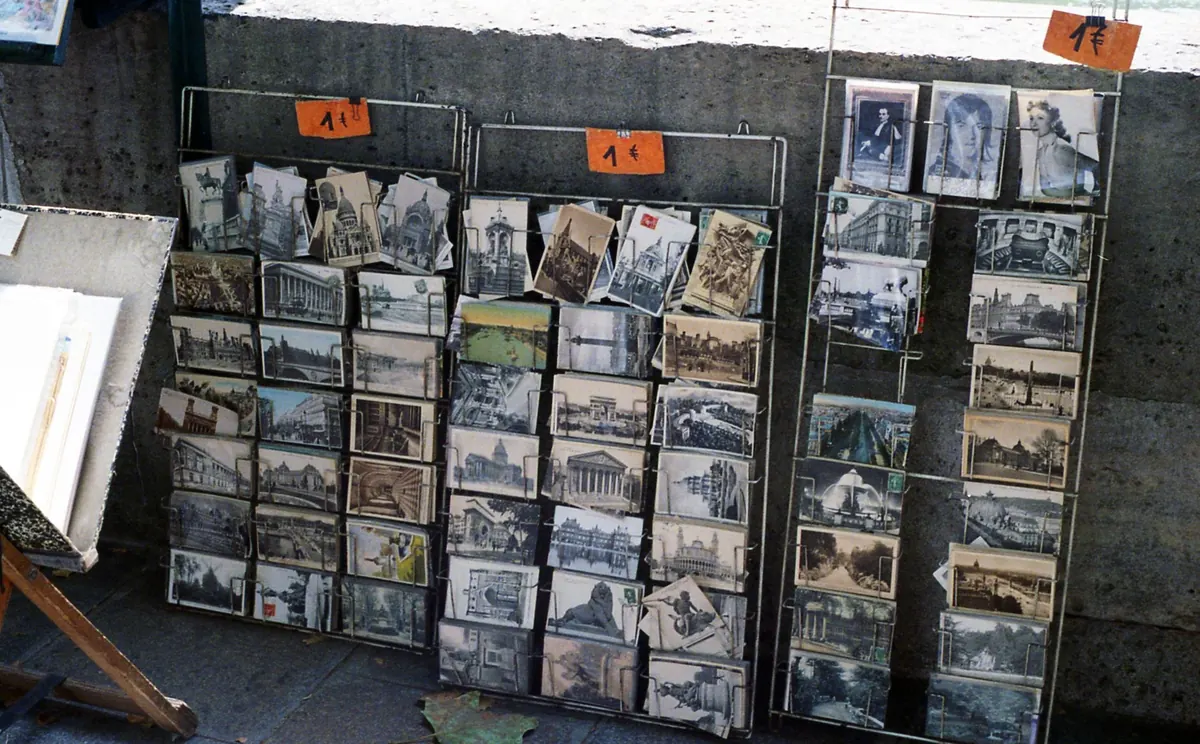
Most postcard collections begin the same way. A few cards come home from a trip, then a drawer slowly fills with sunsets, kittens and interchangeable main squares. There is nothing wrong with that, but the collectors who stay curious for twenty years tend to do one thing differently: they choose a subject and let the subject choose the cards. A theme turns browsing into hunting and a pile into a set. What follows is how to pick a theme with room to grow, keep a record you will actually maintain, and display the result so a visitor understands it at a glance.
Why a theme beats a shoebox
Buying at random is easy. Collecting with a purpose is more interesting. Once you have a subject, you stop flipping past the boxes that matter and start noticing what other people miss: the printer's name in the corner, the shape of a chimney pot, whether the waiter in the photograph is standing or leaning.
A theme also protects your budget. Instead of five mediocre cards, you buy the one that closes a gap. Duplicates become rare, and you gain a ready answer when someone asks why your album stops in 1968 or why there are fourteen pictures of the same bridge.
It helps with display, too. Thirty unrelated cards on a wall look like clutter. Thirty cards of the same square, arranged by decade, look like an exhibition.
Draw the edges before you buy
A theme needs a rule you can say in one sentence. "Postcards of Italy" is a wish. "Postcards of the harbour in Trieste printed before 1970" is a collection, because it can say no. The narrower rule sounds restrictive and is actually liberating: it tells you what to hunt for and when to walk away.
Before you commit, answer three questions for yourself:
- Written or blank? Some collectors only keep cards with a message and a stamp; others want clean picture sides.
- Original or reprint? Decide whether modern reproductions of old images count. Most people keep them in a separate small pile rather than mixing them in.
- How much damage is acceptable? A creased corner is fine for a rare view and irritating on a common one. Set a rough tolerance so you are not deciding from scratch every time.
A good test of scale: can you realistically find ten cards within a year? If yes, the theme will feed itself. If you cannot imagine ever finishing even a section of it, widen the rule slightly. Keep a short note of deliberate exceptions, too. One stray card that does not fit is a memory; twenty are a second collection.
Fifteen themes worth trying
These range from broad to very specific. Any of them can be tightened with a date range, a country or a printing method.
Cities and streets
- One city, decade by decade. The same place across fifty years, arranged chronologically.
- A single square or street. The best themes are often one view repeated: the same fountain, the same corner café, the same row of facades.
- Small towns along one coast or rail line. A ready-made route for a summer trip and a natural limit on what you buy.
- Bridges, fountains, stairways or lighthouses. Pick one structure and follow it. Bridges are especially good because the cards show the city behind them.
- Night views. Rarer than daylight scenes, often more atmospheric, and easy to spot in a dealer's box.
Food and the table
- Market halls and street markets. Stalls, crates, aprons, handwritten prices.
- Regional dishes and bakery windows. Cards printed for restaurants and tourist offices often show local food that never appears on a general view.
- Café terraces and pavement tables. Chairs, awnings, ashtrays, waiters mid-stride.
- Hotel dining rooms and grand restaurants. Interiors age faster than facades, which makes them revealing.
- Shops and bars. Grocers, delicatessens, pastry counters. These cards are harder to find, which is part of the appeal.
The cards themselves
- One publisher or illustrator. A signature in the margin is a theme in itself.
- Hand-tinted cards. Colour applied by hand, with the soft, slightly uneven look that photographs cannot imitate.
- Postmarks from one decade. The picture matters less than the stamp, the date and the message.
- Post offices and postal buildings. A quiet, oddly satisfying subject with a natural link to what a postcard is.
- Odd formats. Panoramas, fold-outs, die-cuts, cards with a strip of perforations.
Keep a record you will actually update
The simplest system wins. A notebook works. A spreadsheet works better once you pass a hundred cards, because you can sort by town or year. Either way, give every card a number and write that number on the sleeve, not on the card itself. Then note:
- Place or subject shown, plus a short description
- Publisher or printer, if visible
- Date printed, or the postmark date if it is written
- Condition in a word or two
- Where and when you found it, and what you paid
Photograph each new card and save the image under its number. It takes a minute and saves arguments with yourself later about what you already own. Keep a separate wish list, short and specific, on your phone. "Three more views of the market hall, especially any before 1950" is useful in a shop; "more food cards" is not.
Store it well, show it often
Paper dislikes light, damp and adhesive. Use archival sleeves or a proper postcard album, keep the boxes out of the attic and the sun, and never tape or glue a card into anything. Handle them by the edges. If a card is valuable to you for reasons of rarity rather than money, a rigid sleeve is worth the small cost.
For display, resist the urge to fill a whole wall. Six or nine cards of the same size, framed in a clean grid, will read as a set; a scattered arrangement of forty will not. Rotate them every few months so the collection stays visible instead of settling into wallpaper. A small binder left on a guest-room shelf, with a handwritten index at the front, invites people to look properly, which is half the pleasure of collecting.
Practical closing: begin with ten cards
Write your one-sentence rule. Pull out the ten cards you already own that fit it, even loosely. Put them in order, whether by date, by street or by subject, and look at what the sequence is missing. That gap is your first real shopping list.
Then set a modest rhythm: one good card a month beats five forgettable ones. Visit fairs and flea markets with your list in hand, ask dealers what they have in your subject, and swap duplicates with other collectors rather than storing them. A theme started this way does not need a big budget or a spare room. It needs attention, and it rewards it for years.
Photo: Ylanite / Pixabay