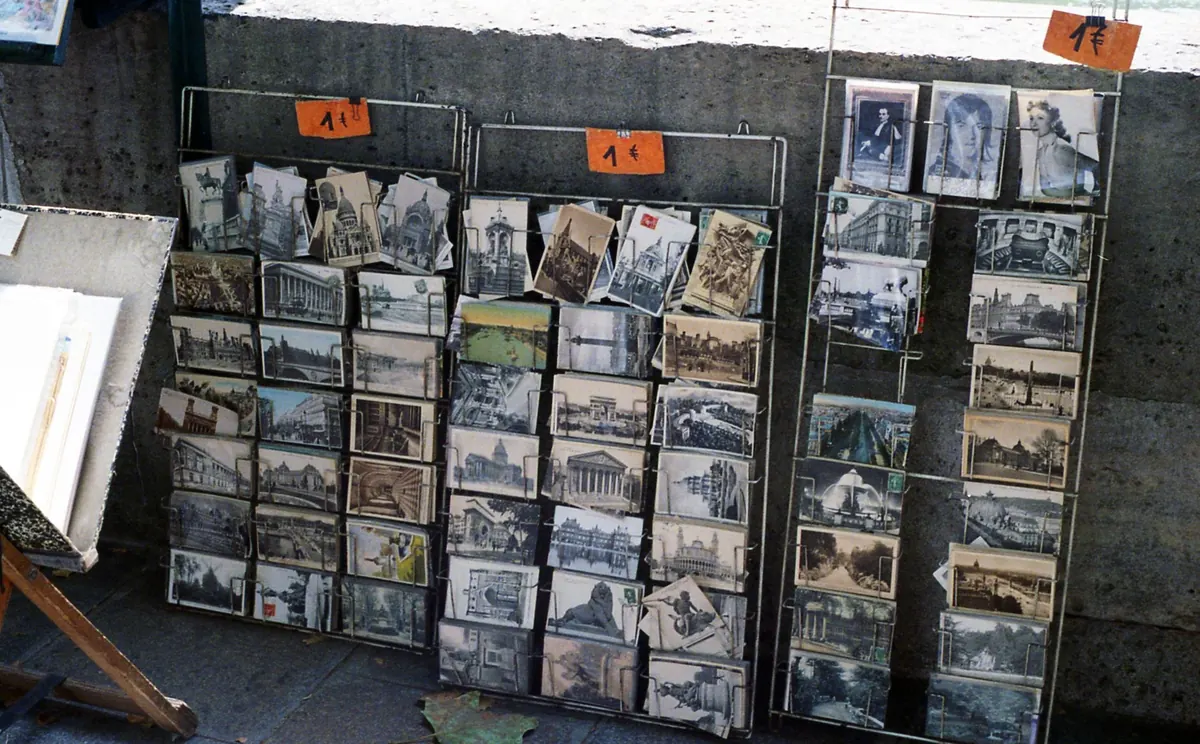
A shoebox of postcards rarely arrives sorted. There are stiff modern cards from museum shops, soft-edged continental views bought on a rainy holiday, and older cards that seem to belong to another measuring system entirely. They usually do. Postcard dimensions have shifted with printing technology, postal rules, and local fashion, and those differences matter the moment you try to sleeve, box, or frame a collection.
Knowing the common formats makes the practical decisions easier. You can buy the right sleeves the first time, spot a trimmed card before you pay for it, and choose a frame that respects the card rather than cropping it. Here is how the main formats compare, and how to work with each one.
Start with the card, not the label
Sellers use size names loosely. A card listed as “continental” may be a standard 4 x 6 inch print, and a “standard vintage” card may turn out to be a trimmed court card. Labels describe a tradition, not a guarantee. The reliable approach is to measure the card yourself, in millimetres, along both edges.
Use a metal ruler rather than a soft tape measure, and work on a flat surface. Measure the shortest edge first, then the longest. Write the figures down in the same order every time, for example 105 x 148 mm. That habit makes a collection far easier to sort later, and it prevents the common mistake of ordering sleeves for a card that is a few millimetres larger than expected.
The standard postcard: 3.5 x 5 and 4 x 6 inches
In the United States, the classic postcard size is 3.5 x 5 inches, roughly 89 x 127 mm. This is the format most people picture when they think of a mid-century travel card: a short, wide rectangle with a divided back and a stamp in the upper right corner. It remained the everyday size for decades and is still common among reprinted and novelty cards.
The other American standard is 4 x 6 inches, about 102 x 152 mm. It is the size of a standard photo print, which explains much of its popularity. Modern tourist cards, greeting-card postcards, and print-on-demand designs often use it. The extra half-inch in each direction gives a more generous image area, and it fits the inexpensive albums and frames sold for photographs.
These two sizes are close enough to be confused in a pile, but not close enough to share a sleeve. A 3.5 x 5 inch card will slide around in a 4 x 6 pocket; a 4 x 6 card simply will not fit into a 3.5 x 5 one. If your collection mixes both, keep two sizes of sleeve on hand.
Continental size: the A6 standard
Across much of Europe, the familiar postcard is the continental size, 105 x 148 mm, which is exactly A6. In inches that is about 4.1 x 5.8, so it sits very close to the 4 x 6 card in overall area but not in shape. A6 follows the 1:1.414 ratio of the A-series papers, while a 4 x 6 card is proportionally a little longer. Place them side by side and the difference is obvious: the continental card looks slightly squarer and more upright.
This is the format of countless European travel cards, museum reproductions, and advertising cards. It also explains why A6 envelopes are so easy to find in Europe and less common in American stationery shops. For collectors, the practical point is that continental cards need their own sleeves. A 4 x 6 pocket will usually hold one, but with enough slack that the card can shift and catch a corner.
Checking the ratio
A quick way to identify a continental card is to divide the long edge by the short edge. If the result is close to 1.41, you are probably holding an A6 card. If it is closer to 1.5, it is more likely a 4 x 6 inch card or a vintage 3.5 x 5.5 inch card. This is not a perfect test, especially for trimmed cards, but it is useful when a seller’s description is vague.
Vintage formats: a rough field guide
Older cards are where measurements become genuinely interesting. Before standardisation, printers worked to their own house sizes, and postal regulations encouraged some formats while discouraging others. The result is a wonderful range of shapes, and a few recurring sizes worth recognising.
- Pioneer and private mailing cards, roughly 1870s to 1898: sizes vary widely, often around 3 x 5 inches or slightly larger. Many have undivided backs, with the message written on the picture side.
- Court cards, around 1898 to 1905: typically about 3.5 x 4.75 inches, noticeably shorter and squarer than later cards. The small format was tied to postal rate rules of the period.
- Divided-back standard, about 1907 to 1930: commonly 3.5 x 5.5 inches, roughly 89 x 140 mm. This is the size most collectors mean by a standard vintage postcard.
- Linen era, roughly 1930 to 1945: often the same 3.5 x 5.5 inch format, printed on textured stock with a visible weave.
- Chrome era, from about 1939 onward: starts at 3.5 x 5.5 inches and gradually moves toward the modern 4 x 6 inch size.
Treat those dates and measurements as general landmarks, not strict rules. A printer might run a card slightly long to fit a decorative border, and decades of storage can leave a card a millimetre or two off. What matters is recognising the family of sizes so you can store them sensibly.
Watch for trimmed cards
Vintage cards are sometimes trimmed to remove a damaged edge or to fit an album page. A trimmed card can measure close to a standard size but feel wrong: the border may be uneven, the printed image may sit too near one edge, or the back layout may look crowded. Compare the margins on all four sides. If one is noticeably narrower, suspect a trim, and price the card accordingly.
Measuring and identifying: a simple routine
- Measure the short edge and the long edge in millimetres, on a flat surface.
- Note the result as short edge first, for example 89 x 140 mm.
- Divide the long edge by the short edge to check the proportions.
- Look at the back: undivided, divided, or modern layout tells you a great deal about the era.
- Check the margins and corners for signs of trimming or rounding.
- Record the measurement on the sleeve or in your inventory before filing the card.
This routine takes less than a minute per card and saves hours of reshuffling later. It is also a quiet pleasure in itself. Measuring a card forces you to look at its edges, its stock, and its printing, and you notice things a quick glance would miss.
Storage and framing: matching supplies to format
Storage
Use sleeves and boxes sized for the formats you actually own. A practical starter set includes pockets for 3.5 x 5.5 inch vintage cards, 4 x 6 inch modern cards, and A6 continental cards. Store cards vertically in a sturdy archival box, not stacked under weight, and avoid PVC sleeves, which can damage paper over time. Polyester or polypropylene pockets are the safer choice. Keep the box in a dry room away from radiators and damp walls.
Framing
Ready-made frames come in 4 x 6, 5 x 7, and A6 sizes, which covers most modern and continental cards. Vintage cards usually need a custom mat or a frame with a generous overlap. Use archival mounting corners rather than tape, and ask for UV-filtering glass if the card will hang in a bright room. Never trim a card to fit a frame; choose a larger frame and a mat instead. For irregular vintage cards, a float mount shows the full edge and looks better than cropping the image.
A practical sorting plan
Sort your collection into three piles: standard, continental, and vintage and odd sizes. Measure anything that does not sit flat in its pile, and set aside trimmed or damaged cards for separate storage. Label the boxes by format, not by subject, so you can find a sleeve without opening everything. Keep a small ruler and a conversion note in the box. Once the sizes are separated, the collection becomes easier to handle, easier to frame, and easier to enjoy.
Photo: Alexas_Fotos / Pixabay