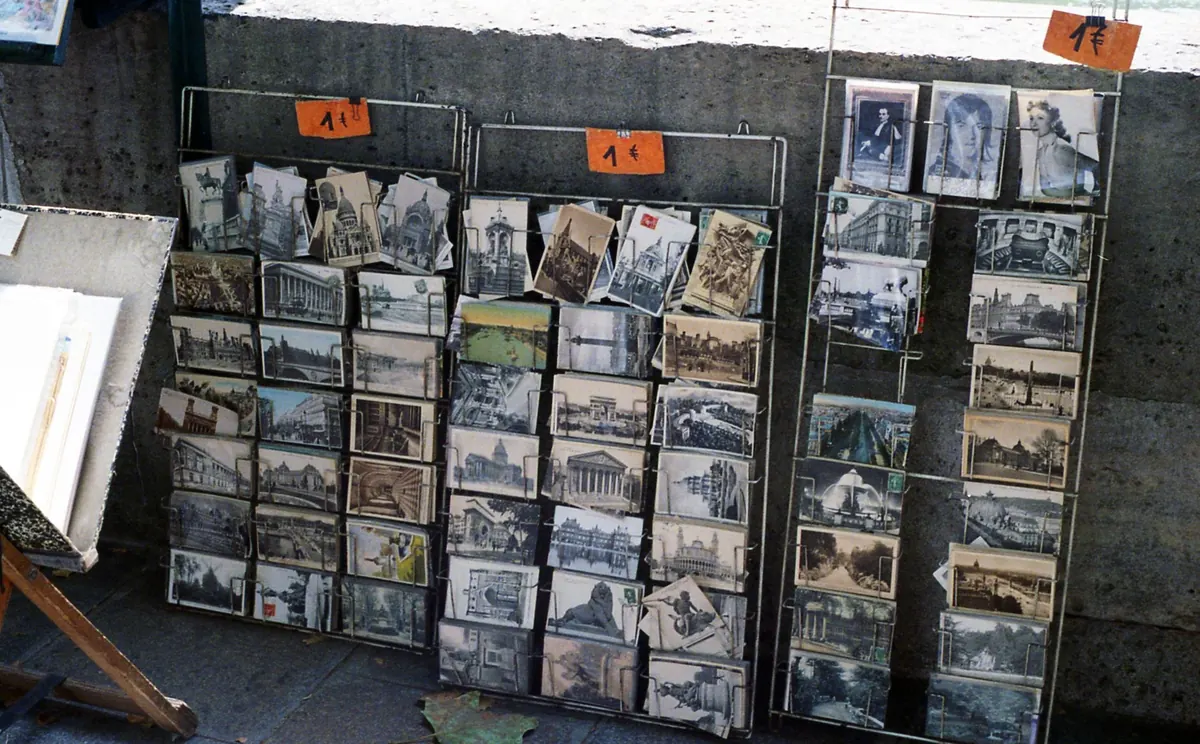
A postcard is a small piece of paper with a long memory. The picture gets the attention, but the back usually does the talking. A postmark, a stamp, a printer’s line, the way the card stock feels between your fingers—each is a small clue. None is a certificate of age on its own. Put them together, though, and you can usually place a card within a believable window of ten or twenty years, sometimes closer.
That is the right aim: not a single birthday, but a defensible date range. Postcards were printed, stored, bought, written, mailed, and sometimes reprinted years after they left the press. The most careful dating treats every mark as evidence and every gap as a reason to stay curious.
Start with the back: divided or undivided?
Turn the card over before you study the image. The layout of the address side is one of the quickest and most useful clues. On an undivided back, the reverse is reserved for the address, with no vertical line down the middle. If there is a message, it usually sits on the front, squeezed around the picture. On a divided back, a line separates the message side from the address side, which is the format most of us recognise today.
As a rough guide, Britain permitted divided backs from 1902, and the United States from 1907. Other countries changed their postal rules at different times, so local history matters. An undivided back generally points to an earlier card, but do not treat it as an absolute cut-off. Printers used up old stock, and a card can be printed before a rule changes but mailed after it. Still, if you see an undivided back with a message crowded onto the picture side, you have a strong reason to look earlier rather than later.
Read the postmark like a sentence
A postmark is often the most precise clue on the card, but it dates the mailing, not the printing. A card postmarked 1913 may have been printed in 1905 and kept in a drawer. A card with no postmark may never have been mailed at all. Read the postmark slowly: town or city, date, sometimes a time code, and the cancellation bars or slogan that tie the stamp to the card.
Handstamps, machine cancels, slogan advertising, railway post office marks, and military postal markings all have their own periods and habits. A clear slogan cancel can narrow a date even when the town is ordinary. A military postmark can place the card in a wartime context, though the picture itself may be older. Check whether the ink of the postmark crosses onto the card as well as the stamp. If the cancellation is neatly confined to a stamp that looks fresher than the card, be cautious: stamps can be added later.
Also compare the postmark’s date with the message. “Having a lovely time” written in July and postmarked in August is not a contradiction; it is simply a card that waited. A postmark from a town far from the pictured place is normal too. The sender’s location is not the photographer’s location.
Stamps and postal rates as quiet timekeepers
Stamps are useful, but they are easily changed. A stamp can be soaked off and replaced, and a dealer or collector may have added a better example decades after the card was mailed. Treat the stamp as supporting evidence, not the main witness. Look at the design, the denomination, the perforations, and the cancellation. A stamp with a modern commemorative design on a card with an early postmark is a warning sign. A stamp whose cancellation ties neatly to the card is more convincing.
Postal rates changed over time, and those changes can help you place a card roughly. A one-cent stamp on a U.S. card often suggests an early twentieth-century mailing; later rates rose. But rates varied by country, by card size, and by whether the card was sent locally or abroad. Use the stamp to confirm a period you have already suspected from the back, the postmark, or the paper. If the stamp is the only clue, keep your date range generous.
Paper, texture, and the feel of the card
Paper is tactile, and that is part of its value as a clue. Older cards often feel stiffer and softer at the same time, with a slight grain and a matte surface. Cards from the white-border era, roughly the 1910s into the 1920s, often have a plain border and a straightforward finish. Linen cards, common in the 1930s and 1940s, show a visible woven texture and a brighter, more decorative look. Chrome cards, with their glossy colour and photographic finish, became common from the late 1930s onward.
Hold the card at an angle. Look for embossing, deckled edges, gilded borders, or a coated surface that catches the light. None of these proves a date by itself, but they narrow the field. Condition matters too: foxing, yellowing, and soft corners tell you about storage and age, not necessarily about the printing date. A clean card can be old; a battered card can be a later reprint. Feel the paper, then look again at the back and the imprint.
Publisher imprints and the small print
The smallest text on a postcard is often the most informative. Publisher names, series numbers, copyright lines, artist signatures, and phrases such as “Printed in Germany” or “Made in the U.S.A.” can point to a production period. German printing was common before the First World War, and its presence on an early card is unsurprising. It does not automatically date a card to the 1900s, but it is a useful piece of the puzzle.
Series numbers can help if you know the publisher’s output, but they are not a universal calendar. A publisher’s address can date an imprint if the firm moved or changed its name. Reprints are the trap here. A card that looks like a 1910 view may be a later photographic reproduction with a modern finish and a publisher’s line from the 1980s. Compare the print quality, the paper, and the back layout. If the image is sharp and the card feels glossy and uniform, ask whether you are looking at a reproduction rather than an original.
When the clues disagree, build a range
Disagreement is normal. A divided back with a 1920s postmark and a “Printed in Germany” imprint is not a contradiction; it is a card with a history. The skill is in deciding which clues are independent and which are likely to have been altered. Use a simple checklist:
- Set the earliest likely date from the back layout, paper, and postal rules.
- Set a later boundary from a clear, original postmark or a datable stamp design.
- Check the publisher imprint, series number, and copyright line for a production window.
- Look for signs of a later stamp, a reprinted image, or a card that was never mailed.
- Prefer the narrowest range supported by at least two independent clues.
- Write down your reasoning, even if it is only a note in pencil on a sleeve.
A date range is more honest than a false exact date. “Circa 1907–1915” is often more accurate than “1909” and far more useful than a guess. If you are cataloguing a collection, keep your notes consistent: record the postmark, the stamp, the imprint, the paper type, and any condition issues. Future you will be grateful.
A five-minute dating routine
When a new card lands on your desk, work in the same order every time. It keeps you from being distracted by the picture.
- Turn it over and note whether the back is divided or undivided.
- Read the postmark for town, date, and cancellation type.
- Examine the stamp and check whether the cancellation ties it to the card.
- Feel the paper and look at the finish, border, and texture.
- Read the publisher imprint, series number, and any copyright line.
- Combine the clues into a range, then mark the card with that range and your confidence level.
Most cards will not surrender a precise date, and they do not need to. A careful range, built from the back, the postmark, the stamp, the paper, and the small print, is enough to place a card in its period and to enjoy it with a clearer eye.
Photo: Ylanite Koppens / Pexels