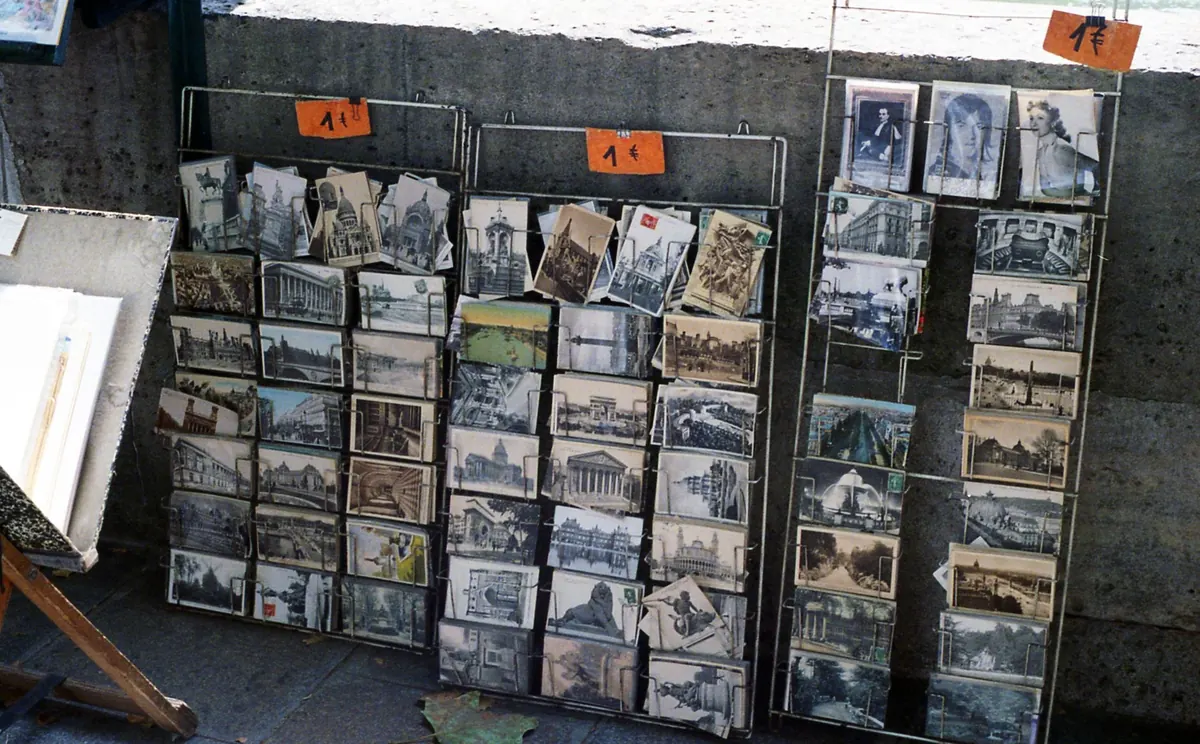
You have been hunting a particular view for months. It finally appears, listed as "very good condition." The scan loads: a diagonal crease across the sky, a rounded corner at the bottom right, and a message in fountain pen faded almost to grey. Very good by one seller's arithmetic, disappointing by yours.
Condition language is a shorthand, and shorthand only works when both people carry the same dictionary. Here are the grades you will see most often on postcard listings, followed by an inspection routine that takes about a minute per card once you are used to it.
What the grades actually mean
Postcard grading borrows its vocabulary from stamps and coins, and most sellers work with five or six steps. No authority enforces the definitions, and no two dealers draw the lines in exactly the same place. Treat the grade as a headline and the written description as the story. When the two disagree, believe the description.
- Mint. As printed, with no handling marks at all. Genuinely mint cards are usually recent, or have sat untouched in a sleeve for decades. Be sceptical of a 1910 card described as mint unless the seller explains why.
- Near mint or excellent. Sharp corners, clean surface, no creases. There may be the faintest trace of handling: one soft corner, a whisper of wear along a single edge. The image is unobstructed.
- Very good. Light, honest wear. Slightly blunted corners, a small nick on an edge, a faint album scuff, perhaps a pencilled price from an old dealer. Nothing that draws the eye at arm's length.
- Good. Here the vocabulary turns treacherous. A "good" postcard is not good in the everyday sense; it is a card with obvious faults. Expect creases, rounded corners, edge chips or a small stain — but a complete card that still displays well.
- Fair. Heavy wear: several creases, staining, tears, a missing corner, or writing that crosses the picture. Worth buying when the card is scarce or the postal history is interesting.
- Poor. Structural damage that compromises the image — large tears, heavy loss, water damage that has eaten into the paper. A placeholder, not a centrepiece.
A card listed simply as "good" is worth a question. Ask what the seller is downgrading for. A straight answer, with a photo, tells you more than any label.
Where the scale gets slippery
Three cases cause most of the arguments. The first is trimming: a card cut down to remove a damaged edge looks crisp in a thumbnail and is worth a fraction of an untrimmed example, so check that the margins are even and the proportions look right. The second is the pressed-through crease — a fold that shows on the back as a clean line and on the front only as a faint ridge in the sky. The third is restoration: bleaching, rebacking, colour touched in. A careful seller will say so. If a card looks strangely white for its age and the price is high, ask directly.
The inspection checklist
Work in the same order every time and you will stop missing the same faults twice.
Corners and edges
- Look at all four corners under light. Sharp, slightly blunted, rounded, or gone?
- Run your eye along each edge. Nicks, chips and the ragged line left by old album mounts are common.
- Check for the dark triangles left by photo corners, and for tape residue along the top edge.
- Compare top and bottom margins. An uneven border usually means trimming, not printing.
The surface
- Tilt the card under a lamp so the light rakes across it. Creases that vanish head-on show up immediately.
- Look for foxing — small brown spots that spread in damp conditions — and for the silvery sheen real-photo cards develop when the emulsion is rubbed.
- Check the sky and any pale area first. Scuffs and indentations hide there and nowhere else.
Stamps and postal markings
- Confirm the stamp belongs. A card that was posted will usually have a postmark tying the stamp to the card.
- Look for a hinge remnant, a thin spot, or a pale rectangle where a stamp was soaked off. A missing stamp should be mentioned in the listing.
- Read the postmark. A clear, dated cancellation is part of the object's interest; a smudged one is a fault worth noting.
Writing and address
- Note whether the message is in ink or pencil, and on which side it sits.
- Check whether the pen has pressed through into the picture. Hold the card up to a window to see it.
- Read the date if there is one. It often settles the printing era more reliably than the caption does.
The back
- Assess the paper tone: cream and even is normal; patchy browning suggests damp.
- Look for album residue, adhesive stains and old hinges, which darken and migrate over time.
- Check the fold of a divided-back card for splits, and the corners for small losses.
A one-minute pass before you buy
- Front and back, in good light, at an angle as well as flat.
- Corners, then edges, clockwise.
- Raking light across the sky for creases.
- Stamp, postmark, and any sign of removal.
- Writing: medium, position, date, penetration.
- Back: tone, stains, tape, splits, missing pieces.
- Margins and proportions, for trimming.
- Ask for a photo of the back if the listing does not show one. Sellers expect the question.
Reading a listing the way an editor reads copy
Most listings are honest and slightly vague, which is why the phrasing matters. "Some wear to edges, consistent with age" usually means the wear is visible in the scan if you look for it. "As shown" without a back view is an invitation to ask. A grade given with no description at all is the least useful kind of listing: you have a label and nothing to check it against.
Ask two questions when you are serious about a card. First, whether there are creases not visible in the photo — the answer is often a useful admission about a corner. Second, whether the card has been trimmed or repaired. Dealers who handle a lot of stock know exactly what you are asking, and few are offended by it.
When wear does not matter much
Condition is not the only measure of a card's interest, and it is rarely the most interesting thing about it. A creased card carrying a long message about a journey, or a postmark from a village post office that closed decades ago, holds information no mint copy can supply. Real-photo cards and scarce local views sell well in fair condition because the alternative is not buying one at all. A practical rule: pay up for condition on common cards, and accept honest wear on cards you may not see again.
Two things are worth avoiding regardless of price. Do not trim a ragged edge to tidy a card up, and do not laminate or tape it. Both are irreversible, and both cost more value than the damage they hide. Store cards flat, in acid-free sleeves, away from damp and direct sun; the best condition work you will ever do happens after you own the card.
Keep this where you buy
Print the checklist, or keep it in a note on your phone. The grade is a starting point, the description is the evidence, and your own inspection under a lamp is the final word. Ask for the back, ask about creases, ask about trimming, and be willing to walk away from a card whose label outruns its photographs. The cards you keep for years will be the ones you examined properly before you paid for them.
Photo: Ylanite Koppens / Pexels